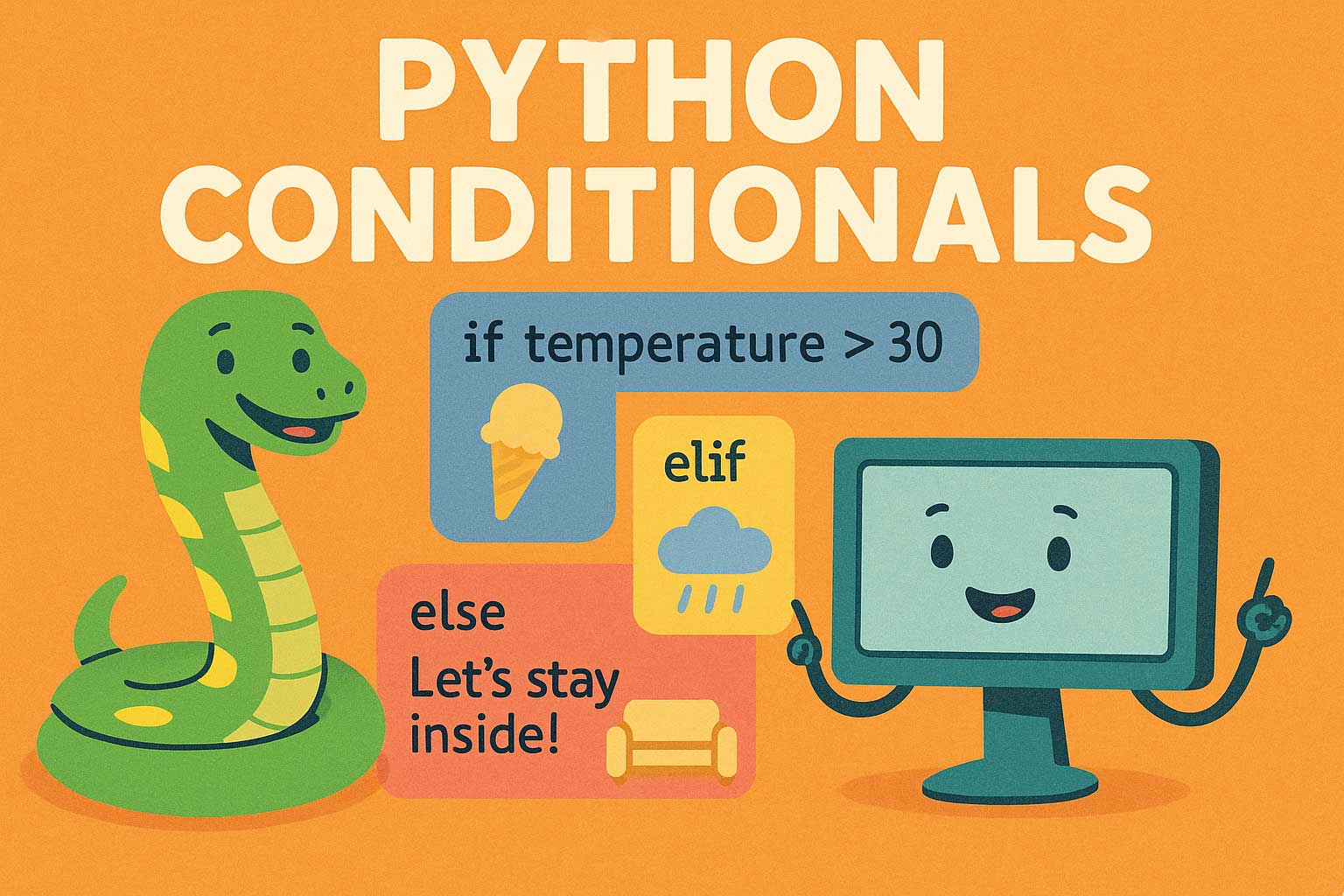
The Beginner-Friendly Guide to “If…, Else…, and Everything in Between!”
Imagine you’re chatting with Python like a friend who listens carefully and responds depending on the situation.
You: “Python, should I take an umbrella?”
Python: “Let me check… If it’s raining: yes. Else: nah, enjoy the sun!”
This is exactly what conditionals do—they help Python make decisions in your code!
Let’s explore them with fun examples (but NOT the ones from your file 👌).
🧠 1. What Are Conditionals?
Conditionals let your program choose different paths based on true or false situations.
It’s Python’s way of saying:
- “If this happens → do that.”
- “Otherwise → do something else.”
- “Or… if something entirely different happens → handle that too!”
Without conditionals, every program would act like a robot with a script—no flexibility, no logic, no personality.
🧩 2. The if Statement
The simplest decision maker.
temperature = 35

if temperature > 30:
    print("It's too hot! Time for ice cream 🍦")
Python checks the condition:
- If True → It runs the code.
- If False → It skips it (no drama).
🔀 3. The if…else Duo
Your “Plan A vs Plan B”.
is_hungry = False

if is_hungry:
    print("Let's eat something! 🍕")
else:
    print("All good, no snacks needed 😌")
Python always chooses one of the two.
🎭 4. elif: When Life Has More Options
In real life, choices aren’t just yes/no.
Sometimes you need: if → else if → else.
score = 72

if score >= 90:
    print("Grade A 🎉")
elif score >= 75:
    print("Grade B 🙂")
elif score >= 50:
    print("Grade C 😐")
else:
    print("Grade D 😬")
Python checks each condition in order,
and stops at the first one that’s true.
🔒 5. Nested Conditionals
Conditionals inside conditionals → like Russian dolls.
age = 20
has_id = True

if age >= 18:
    if has_id:
        print("Entry allowed! 🎟️")
    else:
        print("Sorry, you need an ID.")
else:
    print("You must be 18+ to enter.")
Pro tip:
Use nested if only when necessary—deep nesting makes code confusing.
🤖 6. Using Conditionals With Boolean Expressions
Python conditionals become smarter when combined with:
Logical operators
andornot
is_student = True
discount_today = True

if is_student and discount_today:
    print("You get 50% off! 🤑")
⚡ 7. Conditionals Inside Expressions
Python even has a “mini if-else” you can use in one line.
age = 17
status = "Adult" if age >= 18 else "Minor"
print(status)
Clean, readable, and classy!
🛠 8. Real-World Example:
Should I post this meme?
likes = 150
time_spent = 5  # minutes spent editing meme

if likes > 100 and time_spent < 10:
    print("Post this masterpiece! 🚀")
else:
    print("Hmm... maybe try a better one 😅")
Conditionals = logic + personality = awesome code.
🎉 Conclusion
Python conditionals are your toolkit for creating smart, responsive, decision-making programs.
With if, elif, and else, your code stops being static and becomes dynamic—like a conversational sidekick that reacts exactly how you want.
Leave a Reply